We’re Hiring! Apply To Join Our Team Today


Over 25 years of expert service
How Indoor Air Quality Solutions Impact HVAC Efficiency and Health in Arizona Homes
Your trusted partner for home comfort throughout Gila Valley and White Mountain.
Living in the Grand Canyon State means enjoying vibrant desert sunsets, mild winters, and year-round sunshine. However, whether your home is located in Phoenix, Scottsdale, Mesa, or the surrounding Valley, surviving desert living requires heavy reliance on central heating, ventilation, and air conditioning (HVAC) systems.
During long, scorching summers, where temperatures routinely climb past 110°F, Arizona homes stay tightly sealed to keep cool air inside. While sealing your home’s thermal envelope lowers energy bills, it also creates a closed loop where dust, haboob silt, seasonal pollen, pet dander, and volatile organic compounds (VOCs) become trapped inside your living space.
Many homeowners view indoor air quality (IAQ) products solely as comfort add-ons for allergy sufferers. In reality, modern IAQ solutions directly protect your HVAC system’s mechanical health and operating efficiency. This guide breaks down how desert air impacts your home, how IAQ solutions protect your HVAC equipment, and how whole-home air upgrades improve family health.
The Arizona Air Reality: Dust, Heat, and Sealed Envelope Pressure
To understand why indoor air quality is a major factor for Arizona homes, it helps to examine our unique desert environment:
-
Monsoon Haboobs and Silt: Summer dust storms pull microscopic desert silt into the air. These ultra-fine dust particles easily penetrate window seals, door sweeps, and unsealed ductwork, settling directly inside your air handler.
-
Low Humidity and Dry Ozone: Desert air is naturally dry. Low indoor humidity aggravates nasal passages and eyes, while high ground-level ozone concentrations during hot summer afternoons find their way into residential ventilation networks.
-
High Chemical Off-Gassing (VOCs): High indoor temperatures accelerate volatile organic compound (VOC) off-gassing from household cleaners, paints, furniture, and carpeting. Without proper air exchange, chemical fumes continuously recirculate through your living space.
The Unseen Connection: How Poor IAQ Destroys HVAC Efficiency
When dust and airborne particulates circulate continuously through your HVAC system, they do not just settle on furniture; they coat critical internal mechanical components inside your air handler and outdoor condenser.
1. Evaporator Coil Insulating Layer
Your air conditioner’s evaporator coil relies on bare aluminum fins to absorb heat from indoor air. When fine desert dust and pet hair bypass basic filters, they mix with coil condensation to form a thick, muddy mat over the coil fins.
Dust acts as a thermal insulator. Just a 1/16th-inch layer of dirt on an evaporator coil can reduce heat transfer capacity by up to 20%, forcing your compressor to run longer, high-draw cooling cycles to satisfy the thermostat.
2. Airflow Restriction and High Static Pressure
Accumulated debris inside air ducts and on blower motor blades increases system static pressure. High static pressure restricts overall airflow through your vents, forcing fan motors to work significantly harder, accelerating electrical component wear, and spiking monthly electric bills.
3. Frozen Evaporator Coils and Compressor Failure
When dust severely restricts airflow across the evaporator coil, the refrigerant inside the copper tubing cannot absorb sufficient heat. The coil temperature drops below freezing, turning ambient condensation into a solid block of ice. Frozen coils block airflow entirely and can cause liquid refrigerant to flood back into the compressor, leading to catastrophic motor failure.
4 Whole-Home IAQ Solutions That Boost Efficiency and Health
Upgrading your home’s indoor air quality infrastructure creates a multi-layered defense system that protects both family health and mechanical equipment.
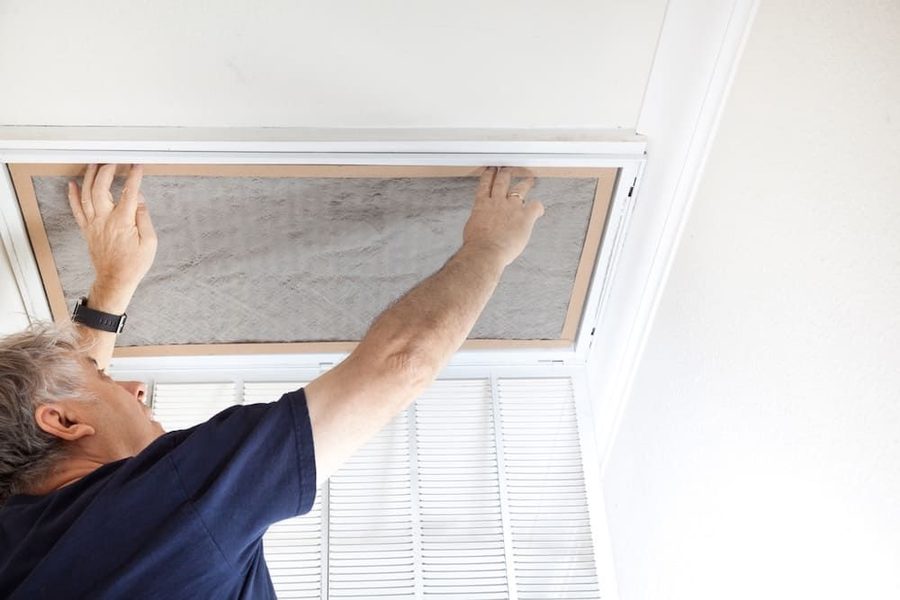
1. High-Efficiency Deep-Pleated Media Filters (MERV 11–13)
Standard 1-inch fiberglass filters are designed only to catch large dust bunnies to protect the fan motor; they do almost nothing to clean the air you breathe or trap fine desert silt.
Upgrading to a 4-inch or 5-inch deep-pleated media filter rated at MERV 11 to MERV 13 captures up to 90% of airborne particulates, including fine dust, pollen, mold spores, and pet dander, down to 1.0 micron. Because deep-pleated filters offer greater surface area, they capture significantly more debris without restricting system static pressure.
2. Germicidal UV-C Light Systems
Because an air conditioner evaporator coil is wet during summer cooling, dark air handler cabinets provide an ideal breeding ground for mold, mildew, and bacterial colonies.
Installing an ultraviolet (UV-C) germicidal light system directly above or below the evaporator coil shines continuous, high-intensity UV energy onto the coil fins and drain pan. UV-C light sterilizes organic micro-organisms, preventing bio-film buildup on coil fins and keeping heat transfer surfaces completely clean without harsh chemical sprays.
3. Whole-Home Air Purifiers and Photo-Hydro-Ionization (PHI)
Advanced whole-home air purifiers (such as the RHO-Remedy or Reme Halo systems) install directly into the main supply duct. Utilizing Advanced Oxidation Technology, these systems produce low-level hydrogen peroxide plasma that travels throughout every room in your home.
This active plasma neutralizes airborne viruses, bacteria, VOCs, smoke, and cooking odors on contact, while causing fine dust particles to clump together so your main media filter can trap them more efficiently.
4. Energy Recovery Ventilators (ERVs)
Because homes are built tight to keep desert heat out, stale indoor air becomes trapped. An Energy Recovery Ventilator (ERV) exchanges stale indoor air for fresh outdoor air while pre-cooling and managing the incoming air stream. This prevents chemical VOC buildup, exhausts trapped odors, and introduces fresh oxygen into your living spaces without wasting energy.
Protect Your Comfort, Health, and HVAC Investment
Taking control of your home’s indoor air quality is one of the most effective ways to lower summer electric bills, eliminate persistent dust, reduce seasonal allergy symptoms, and extend the operational lifespan of your heating and cooling equipment.
While changing a standard 1-inch air filter is a great routine habit, evaluating static duct pressure, sizing high-efficiency media cabinets, and integrating germicidal UV or PHI purification systems requires commercial equipment and certified trade expertise.
Investing in professional indoor air quality solutions ensures your Arizona home remains cool, clean, healthy, and energy-efficient through every season.
Trust the Experts at Advanced Air Systems
You do not have to battle desert dust, high electric bills, or seasonal allergies alone. The background-checked, certified master technicians at Advanced Air Systems specialize in comprehensive indoor air quality audits, high-efficiency filtration, duct sealing, UV sterilization, and complete HVAC maintenance across Arizona.
Contact Advanced Air Systems or schedule your indoor air quality service!

Leave Your Home Comfort To Us!
From routine maintenance to complete system replacements, Advanced Air Systems delivers reliable comfort solutions you can count on. Our experienced technicians focus on quality work, honest service, and keeping your home comfortable year-round.